Arrows Lined Letter Tracing: More Than Just a Font
When you first encounter the Arrows Lined Letter Tracing font bundle, it might seem like a straightforward tool for educators. And it is that, brilliantly so. But as someone who has spent years navigating the intersection of design and communication, I see a much broader potential. This isn't just a collection of letters; it's a system for teaching clarity, a framework for building foundational skills, and a surprisingly versatile asset for a range of creative projects. The core of its appeal lies in its dual nature: it provides both the solid, confident strokes of finished letters and the dotted, arrow-guided pathways that teach how to form them.
The Anatomy of a Teaching Typeface
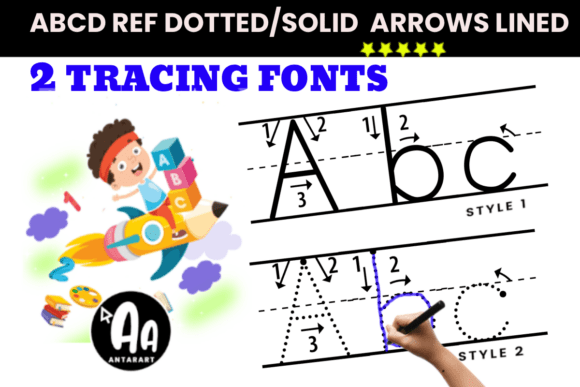
Let's break down what makes the Arrows Lined Letter Tracing set visually distinctive. At its heart, it's a premium font designed with a very specific purpose: instruction. Each character comes in multiple styles. You have the clean, solid letterforms that represent the final goal. Then, you have the dotted versions, where the letter is composed of a series of points, tracing the exact path a student's pencil should follow. Finally, and most crucially, you have the lined arrow style. This version features directional arrows overlaid on the letter, showing the starting point and the sequence of strokes.
The personality here is one of guidance and patience. It's not a flashy display font trying to shout for attention. Instead, it's a supportive handwritten font with a clear, instructional voice. The style is based on traditional school handwriting, which gives it an immediate sense of familiarity and trust. This isn't a trendy, modern script; it's a functional tool meant to build muscle memory and confidence. Its overall appeal is in its simplicity and its directness—it solves a very real problem for teachers, parents, and designers creating educational materials.
Beyond the Classroom: Unexpected Applications
While the primary audience for Arrows Lined Letter Tracing is clear—preschool, kindergarten, homeschool, ESL, and special education teachers—its utility extends into areas you might not initially consider. Think about brand identity for a children's tutoring service, a pediatric occupational therapy clinic, or an educational app. Using this font in marketing materials instantly communicates expertise and a hands-on approach to learning. It tells parents, "We understand the fundamentals of how children learn to write."
For content creators and bloggers in the education or parenting niche, this font is a goldmine. Imagine creating downloadable worksheets, printable alphabet posters, or social media graphics that teach letter formation. The font does the heavy lifting, ensuring consistency and accuracy across all your materials. A crafting entrepreneur selling educational printables on Etsy could use this bundle to create hundreds of unique products without starting from scratch each time. It becomes a core part of their design assets library, streamlining their workflow and enhancing their product's perceived value.
Strategic Font Selection and Pairing
Choosing the right font is a strategic decision. When would you select the Arrows Lined Letter Tracing set? The answer is whenever your project's goal is to teach, guide, or demonstrate a foundational process. It's perfect for activity books, classroom posters, instructional handouts, and interactive digital worksheets. It's less suited for a high-fashion magazine or a luxury brand's logo, but that's not its purpose. Its strength is in its specificity.
A key consideration is font pairing. Because this is a highly functional, instructional typeface, it pairs best with clean, simple companions. A neutral sans serif font like Open Sans or Lato for body text will provide excellent readability without competing for attention. If you need a bit more personality, a friendly, rounded serif font could work for headings. The goal is to create a clear visual hierarchy where the tracing letters are the undeniable focal point of the activity. Avoid pairing it with ornate script fonts or overly decorative typefaces, as this would undermine its core purpose of clarity.
Practical Guidance for Implementation
Before diving in, take time to evaluate the specific project fit. Does your audience need directional guidance? If yes, the arrow styles are invaluable. If you're only creating final, traceable worksheets, the dotted style might be sufficient. Review the included styles thoroughly; a good bundle will offer variations to keep your materials fresh.
Readability is paramount. Test the font at the size it will be used. The dotted lines and arrows must be distinct enough for a young child's developing motor skills to follow easily. For digital applications, ensure the font renders cleanly on screens. Finally, always verify the commercial licensing. A reputable creative font will offer clear terms for both personal and commercial use, which is essential if you're selling worksheets or using the font in client work. This isn't just about legality; it's about professional integrity.
In the end, the Arrows Lined Letter Tracing font is a testament to the power of purposeful modern typography. It proves that a typeface doesn't need to be revolutionary to be indispensable. By focusing on a clear, universal need—teaching the foundational skill of handwriting—it becomes a powerful tool for educators and a surprisingly strategic asset for a wider creative community. It builds more than letters; it builds confidence, one stroke at a time.