Destroy Glass: Where Blackletter Tradition Meets Modern Edge
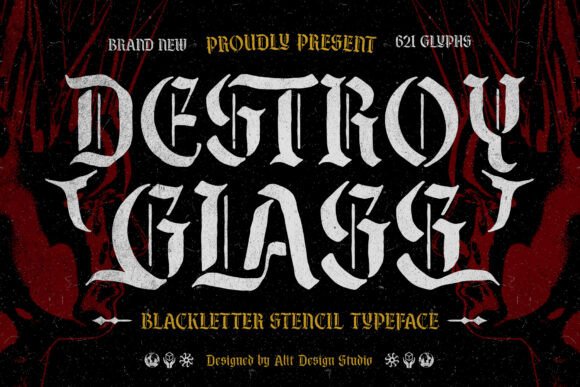
There’s a specific kind of visual tension that commands attention—the collision of old-world craft and contemporary defiance. It’s the feeling you get from a perfectly worn leather jacket paired with a crisp white shirt, or a centuries-old cathedral illuminated by neon. This is the territory Destroy Glass occupies. It’s not just a blackletter stencil typeface; it’s a statement piece for designers who understand that true boldness lies in the balance between reverence and rebellion.
Visually, Destroy Glass takes the foundational forms of traditional blackletter—the dramatic thick-thin strokes, the angular joints, the dense, vertical rhythm—and introduces a deliberate, controlled disruption. The stencil cuts aren’t random; they’re strategic interruptions that breathe modern air into the historic letterforms. This gives the typeface a unique duality. Up close, you appreciate the intricate, almost architectural detailing of each glyph. From a distance, the stenciled breaks create a powerful, almost industrial texture that grabs the eye. It’s a premium font that feels both handcrafted and engineered.
Practical Applications: Beyond the Aesthetic
Where does a font with this much personality actually work? The key is to think of it as a display font—a tool for headlines, logos, and impactful moments, not for body text. Its strength is in creating an immediate mood and setting a visual tone.
- Branding & Logo Design: For brands targeting an audience that values authenticity, edge, and a touch of the subversive, Destroy Glass is a goldmine. Think craft breweries, boutique distilleries, independent record labels, tattoo studios, or high-end streetwear. It instantly communicates a brand identity that is confident, knowledgeable, and unafraid to stand out. A logo set in Destroy Glass tells a story before a single word of copy is read.
- Editorial & Packaging Design: In editorial design, use it for chapter titles, feature article headers, or pull quotes in magazines covering music, art, or alternative culture. For packaging design, it can elevate products like artisanal hot sauces, dark-roast coffee blends, or limited-edition vinyl releases. The stenciled quality adds a tactile, handmade feel that resonates with consumers seeking authenticity.
- Digital & Social Media: On web design, deploy it for hero section headlines or event announcements where you need immediate impact. For social media graphics, it’s perfect for creating scroll-stopping posts, podcast cover art, or YouTube thumbnails. The font’s inherent drama translates exceptionally well to screens, especially when used at large sizes with high contrast.
- Personal & Commercial Projects: Don’t limit it to client work. As a creative font, it’s fantastic for personal projects like concert posters, band merch designs, custom apparel graphics, or even standout invitations for a themed event. Its versatility as a commercial font means these personal explorations can easily become sellable products.
Making It Work: Guidance for the Thoughtful Designer
Adopting a typeface like Destroy Glass requires a bit of strategy. Its power is immense, but so is its visual volume. Here’s how to integrate it effectively.
First, evaluate project fit. Does the project’s core message align with themes of heritage, craftsmanship, rebellion, or bold individualism? If you’re designing for a serene yoga studio or a minimalist tech startup, this font will likely feel dissonant. But for a heavy metal festival poster or a vintage motorcycle shop, it’s a natural fit.
Next, master the art of the font pairing. Destroy Glass needs a counterbalance. Pair it with a clean, geometric sans serif font for body text to ensure readability and create a clear hierarchy. A simple, elegant serif font can also work for a more classic, yet still edgy, composition. Avoid pairing it with other highly decorative or script fonts, as this will create visual chaos. Let Destroy Glass be the soloist, not part of a noisy choir.
Pay close attention to readability considerations. At small sizes or in long sentences, the intricate blackletter forms and stencil breaks can become a jumble. Use it sparingly—large and proud. Test your layouts at the intended viewing distance. What looks stunning as a 72-point headline on your monitor might become an illegible smudge on a printed business card.
Finally, understand what you’re getting. Review the font’s included styles. Does it come with alternates, ligatures, or extended language support? Knowing the full toolkit allows you to customize and refine your typography. And always, always clarify the commercial licensing terms. Ensure the license covers all your intended uses, whether it’s for a single client project, unlimited print runs, or digital products for sale. This is a non-negotiable part of professional practice.
In the end, choosing Destroy Glass is a deliberate creative decision. It’s for the designer, the entrepreneur, the creator who wants their work to feel grounded in history yet fiercely contemporary. It’s a typeface that doesn’t just display words—it amplifies a message. Used with intention, it becomes more than a design asset; it becomes the cornerstone of a visual language that is both bold and elegantly defiant.